When the natural lens loses its abilities — whether it first becomes presbyopic and then progressively develops a cataract — the choice of the implant that replaces it largely determines the quality of vision for years to come. This choice is not standardised: it depends on your expectations, your lifestyle and the specific characteristics of your eye.
Why the choice of implant is a refractive decision
When the natural lens is removed — whether as part of cataract surgery or a refractive lens exchange — it is replaced by a permanent artificial implant. This implant corrects the refraction of the eye: it is an optical decision as much as a surgical one.
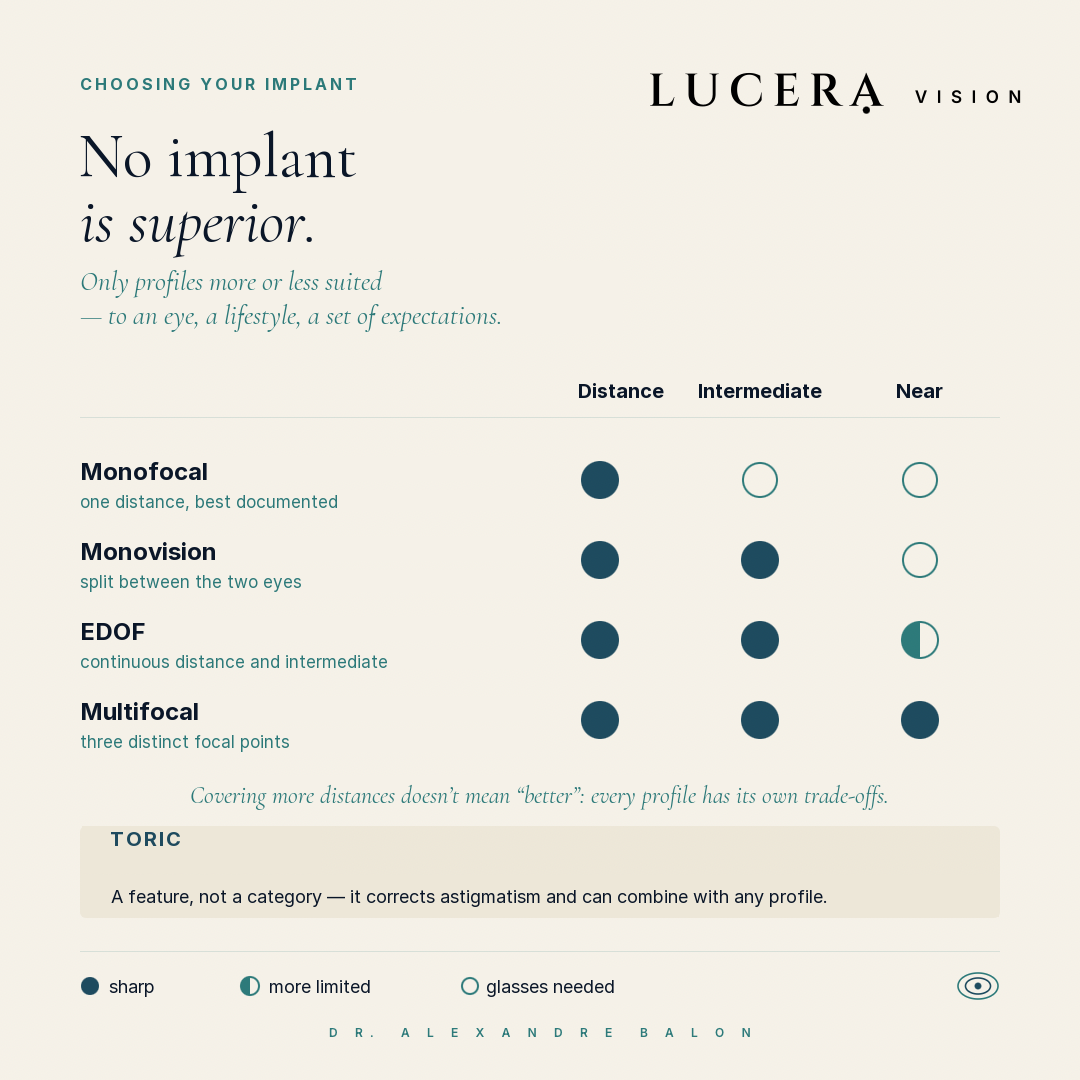
The standard monofocal IOL, the oldest and most widespread, corrects a single distance — usually distance vision. It is effective, well documented, and covered by health insurance. But it leaves the patient dependent on glasses for the distances that are not corrected. For many people, this is a perfectly acceptable trade-off. For others, the goal is to go further.
This is where the discussion about so-called “premium” implants comes in — not because they are superior in absolute terms, but because they meet different expectations, with different trade-offs, and are not covered by the Belgian social security system, although some supplementary insurers do reimburse them.
Monovision: a simple option, often overlooked
Before turning to multifocal implants, I wanted to present a more discreet option: monovision. The principle is simple — one eye is corrected for distance vision, the other for intermediate vision. The brain quickly learns to select the more useful eye depending on the situation.
Monovision suits patients who want partial spectacle independence without the constraints of multifocal implants. It does, however, have its limits: stereopsis — the fine perception of depth — is reduced, which can interfere with certain precision activities. It does not suit everyone, and the discussion during the consultation generally makes it possible to determine this fairly quickly.
Extended depth of focus (EDOF) implants
EDOF implants do not create two distinct focal points, but instead extend the range of sharp vision along a continuum. In practical terms, distance vision and intermediate vision — screens, dashboard, prices on a shelf — are generally excellent. Near vision, for small print or in low-light conditions, remains limited.
This profile is particularly suited to active patients, heavy users of screens or frequent drivers, who accept wearing light glasses for reading. Night-time light phenomena — halos, reflections — exist but generally remain close to those of monofocal implants.
Full depth of focus implants — multifocals
Multifocal implants create several distinct focal points — typically three — allowing sharp vision at different distances simultaneously. For well-selected patients, they offer near-total spectacle independence in daily life.
They are also the most demanding implants — for the patient as well as for the surgeon.
Night-time halos are the most frequently mentioned trade-off. I explain to my patients that these halos are produced by the diffractive rings etched onto the implant — the very rings that allow them to see up close. In a sense, the halos are proof that the implant is working. In the great majority of cases, the brain gradually adapts through a process of neuroadaptation: the halos fade, become less conscious, and stop being bothersome. This adaptation takes a few weeks to a few months depending on the individual.
Even so, this adaptation process is not universal, and anxious or perfectionist profiles, or those who are very demanding about night-time optical quality, deserve an in-depth discussion before choosing this option, which remains a trade-off.
Toric implants: correcting astigmatism
“Toric” is not a category of implant in its own right — it is an additional characteristic. An implant can be monofocal toric, EDOF toric or multifocal toric. The correction of astigmatism is built directly into the optics of the implant, at a precise axis.
In patients with significant corneal astigmatism, failing to correct it during surgery would leave a residual imprecision that would limit the benefit of the chosen implant. Preoperative biometry and intraoperative axial marking are therefore particularly rigorous in this context.
How the choice is made during the consultation
There is no implant that is objectively superior to the others. There are implants that are more or less suited to a given profile.
During the consultation, the criteria I assess are many: your real visual expectations, your main activities, your tolerance for trade-offs, your sensitivity to light phenomena, and of course the biometric and anatomical data of your eye. A history of corneal refractive surgery, particularly laser surgery, also alters the implant calculation and deserves particular attention.
This discussion takes time. That is normal — it determines a permanent result.
From presbyopia to refractive cataract surgery
The implant choice described in this article applies to two distinct clinical situations: refractive lens exchange in a presbyopic patient without cataract, and cataract surgery itself. The surgical technique is identical in both cases. What differs is the moment at which the indication is made — and the goals we set together.
To understand when refractive lens exchange is indicated and who it is for, you can read the article: “Beyond the laser: lens surgery to correct presbyopia”.
This page presents general guidance drawn from my practice and current scientific literature. Each situation is assessed individually in consultation, on the basis of a complete preoperative assessment. It is not a substitute for personalised medical advice. — Dr Alexandre Balon, ophthalmic surgeon, Clinique Saint-Pierre Ottignies.