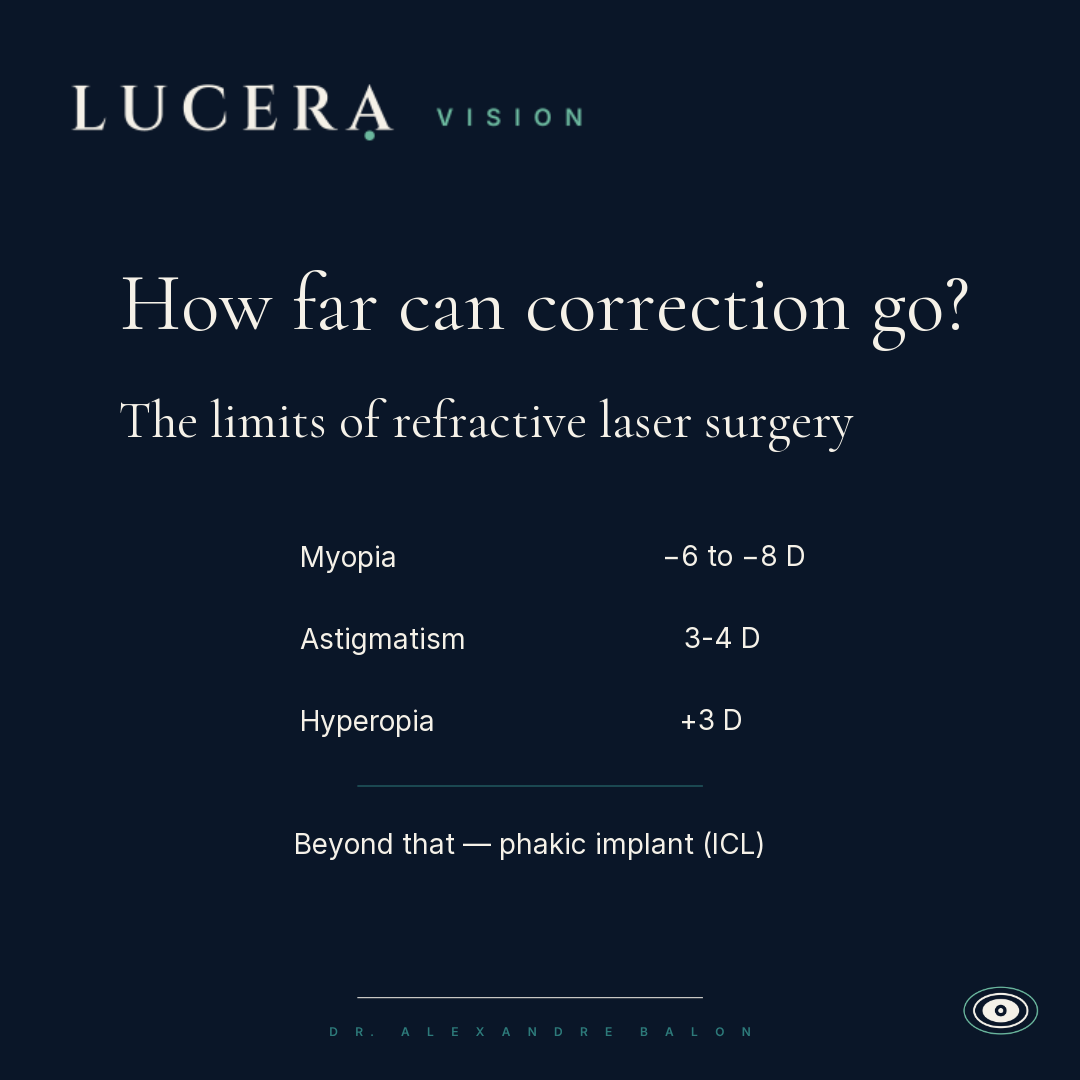
Severe myopia, hyperopia, astigmatism: each situation has its own technical limits. Understanding these limits means understanding why the indication always comes before the choice of technique.
Myopia: the laser has its limits
Corneal laser surgery — whether LASIK, transPRK or KLEx — works by reshaping the surface of the cornea to alter its refractive power. This approach is highly effective, but it is limited by the corneal thickness and shape available after treatment.
In practice, I generally offer corneal laser surgery up to around −6 to −8 dioptres of total myopia, and up to 3 to 4 dioptres of astigmatism depending on the corneal profile. Although some surgeons choose to correct beyond this, the threshold is not arbitrary — it follows the recommendations of several scientific societies: the imprecision of the correction and the risk of myopic regression increase slightly from −6.00 dioptres, and far more markedly beyond −8.00 dioptres. In addition, the residual corneal tissue may become insufficient to ensure the long-term biomechanical stability of the eye. A progressive deformation of the cornea — known as ectasia — is a rare but serious risk that we work rigorously to prevent.
Worth noting — These values are clinical reference points, not universal rules. Every decision rests on a complete map of your cornea (topography, pachymetry, biometry). Two patients at −7 dioptres can have very different profiles.
When the laser is no longer enough: the phakic implant
Beyond the limits of the laser — or when the cornea has characteristics that contraindicate treating it — an alternative exists: the phakic implant. This is a corrective lens placed inside the eye, in front of the natural lens, without removing or touching it.
The best-documented implant for this indication is the ICL (Implantable Collamer Lens), able to correct myopia up to −18 dioptres depending on the model, and more with the IPCL. Its long-term safety profile is now well established in the literature. Other implants, as well as combinations of techniques (bioptics), make it possible to correct even higher degrees of myopia.
The main constraint of this technique is anatomical: the implant must coexist with the structures of the eye without exerting pressure on the natural lens or blocking the circulation of the aqueous humour. This requires a sufficient anterior chamber depth — measured during the consultation, it must generally exceed 2.8 mm in myopic eyes, and 3.0 mm in hyperopic eyes. An eye that is too small or too narrow may not offer the necessary space, which then rules out this option.
Hyperopia: a correction that is harder to stabilise
Hyperopia poses a different problem. Unlike myopia, where the cornea is thinned, correcting hyperopia with the laser requires increasing its central curvature — a more demanding step in terms of stability, which also induces more postoperative dry eye.
In practice, going beyond +3 dioptres with the laser carries an increased risk of regression of the result over time, as well as more pronounced and more lasting dry eye. Some surgeons treat beyond this threshold — techniques and knowledge are evolving — but the benefit/risk balance warrants a careful, individual discussion.
The phakic implant in hyperopia: an option rarely available
One might think that the phakic implant represents the same alternative here as in severe myopia. Unfortunately, this is not the case. The hyperopic eye is often naturally shorter, with a narrower anterior chamber; the space available to accommodate an implant is frequently insufficient. Severe hyperopia in a young patient thus represents one of the last ambiguous and debated frontiers of refractive surgery.
An option to consider after 45 — When neither the laser nor the phakic implant is feasible — or when presbyopia sets in and the natural lens loses its flexibility — refractive lens exchange may be discussed from around the age of 45. This is the same procedure as cataract surgery, performed in a preventive or refractive setting, with the choice of an implant suited to the patient’s visual goals. This decision warrants a dedicated consultation.
If your cornea has already been treated with a laser, the question arises differently on the day a cataract appears: the implant calculation then relies on specific formulas, because the geometry of the cornea has changed. You can read the page: “Cataract after laser surgery”.
This page presents general guidance drawn from my practice and current scientific literature. Each situation is assessed individually in consultation, on the basis of a complete preoperative assessment. It is not a substitute for personalised medical advice. — Dr Alexandre Balon, ophthalmic surgeon, Clinique Saint-Pierre Ottignies.