Presbyopia is inevitable. The laser can lessen its impact under certain conditions, but it does not remove it — because it acts on the cornea, whereas presbyopia comes from the crystalline lens. For some profiles, it is this lens itself that needs to be considered for treatment.
The laser and presbyopia: what it can and cannot do
Corneal laser surgery works by reshaping the surface of the cornea. It can create a slight asymmetry between the two eyes — a controlled monovision — and/or induce a relative multifocality that widens the range of sharp vision. For many emmetropic or slightly myopic patients, this approach, known as PresbyLASIK, effectively postpones the need for reading glasses for years.
But the laser does not restore lost accommodation. Presbyopia is a lenticular phenomenon: the crystalline lens gradually stiffens and loses its ability to change its curvature to focus up close. No procedure on the cornea can compensate for this loss in the long term.
In myopic patients, I almost always favour the laser when it is technically possible — for a reason that is not solely optical. The myopic eye is anatomically longer, and removing the crystalline lens in this profile increases the risk of postoperative retinal detachment. This is a rare but real risk, which justifies reserving lens surgery for situations where it is genuinely necessary in the group of myopic patients.
What is refractive lens exchange?
The procedure is identical to that of cataract surgery, one of the most frequently performed and best-documented procedures in modern medicine. The difference lies in the indication: it is carried out before a cataract has formed, with a refractive intent — that is, to correct vision rather than to treat an opacification.
The ageing natural lens is removed through a micro-incision, then replaced by a permanent artificial implant. This implant is calculated to measure from the biometric data of your eye, and chosen according to your visual goals — distance vision only, or broader spectacle independence thanks to an extended depth of focus or multifocal IOL.
The surgical technique is mature. The procedure is short, performed as a day case, and the scientific track record for this type of procedure spans several decades.
Who is this option for?
Two patient profiles regularly come up in consultation for this indication.
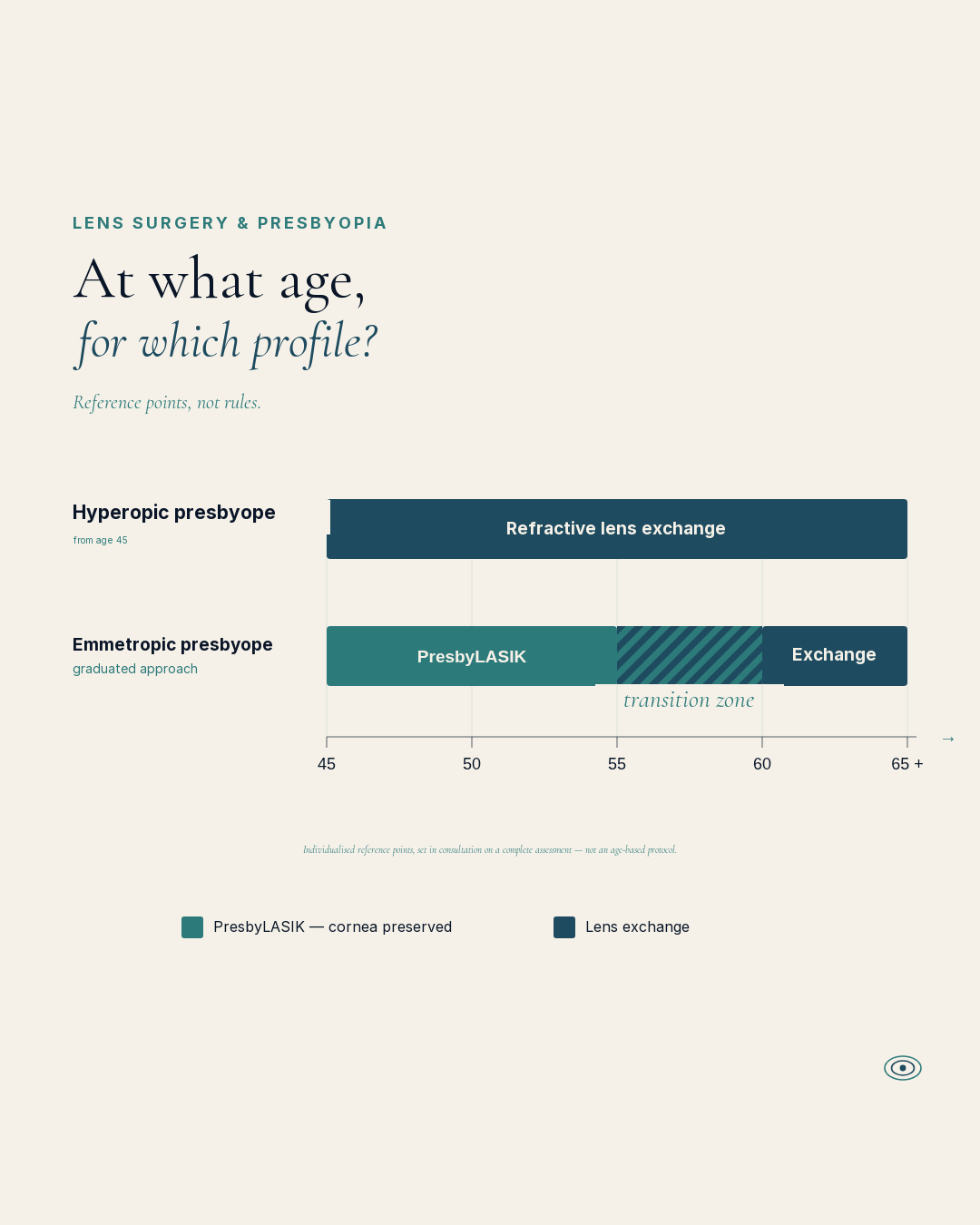
The hyperopic presbyope — often from the age of 45. For this patient, the laser has always been limited in its ability to durably correct hyperopia. Now that presbyopia is added, lens surgery becomes the most coherent option: it treats the loss of accommodation and the residual hyperopia simultaneously. I offer this route from the age of 45 for these profiles, because waiting generally brings no benefit. Abstaining nevertheless remains an option as long as distance vision remains comfortable.
The emmetropic presbyope who can no longer tolerate reading glasses. For this patient, the approach is graduated. Between 45 and 55–60 years of age, I generally offer PresbyLASIK when the cornea is suitable — it is a less invasive solution that preserves the natural lens and its residual accommodation. Beyond 55–60 years, when accommodation is almost entirely lost and a cataract is beginning to degrade visual quality, lens exchange becomes the most durable option.
These are reference points, not rules. The choice is built during the consultation, on the basis of a complete assessment and your real expectations.
Narrow angle. Hyperopic eyes, being shorter, more often have a narrow angle, which is part of the assessment before refractive lens exchange. When this is the case, the procedure improves vision and reopens the angle at the same time. Cataract and glaucoma: the narrow angle →
The loss of accommodation: understanding what is being exchanged
This is the point I make a particular effort to discuss with every patient.
Even when presbyopic, your natural lens retains a residual accommodation. It is weak, often insufficient to read comfortably without glasses — but it exists, and it continues to play a role in the smoothness of intermediate vision. Replacing the lens with an implant permanently removes this accommodative capacity, because no current implant truly reproduces the natural accommodative mechanism.
Extended depth of focus (EDOF) or multifocal IOLs functionally compensate for this loss, but through an optical mechanism — by widening the range of sharpness or by creating several focal points — and not through active accommodation. The result can be excellent, but it differs qualitatively from the vision of a young lens.
For a 45-year-old patient, this is a permanent commitment that it is essential to understand before deciding. This is precisely why I take the time to explain how each type of implant works and the trade-offs it involves — a subject to which I have devoted a dedicated article.
Refractive cataract surgery: same procedure, different indication
When the lens begins to lose its transparency — even subtly — the exchange no longer concerns a clear lens, but a lens that is progressing towards a cataract. The procedure then becomes cataract surgery with a refractive aim.
The surgical technique remains identical. What changes is the context of the decision: the procedure will be necessary in any case sooner or later, and the question simply becomes when to carry it out and with which implant. For many patients, this is the stage at which the choice becomes most serene — the procedure is indicated in any case, so it makes sense to use it to durably optimise vision.
The consultation pathway
The decision to consider lens surgery rests on a complete preoperative assessment: precise biometry, corneal topography, retinal and macular examination, and an analysis of your visual profile and your expectations.
My role is to establish an indication and to explain what it involves. Your role is to define what you genuinely expect from your vision — and the unavoidable trade-offs that presbyopia entails. This discussion takes time, and that is normal: we are talking about a permanent decision.
To understand how the implant that will replace your lens is chosen, you can read the article: “Choosing your implant: from presbyopia to refractive cataract surgery”.
To understand the limits of the laser and the alternatives in refractive surgery, you can read the article: “How far can vision be corrected with laser or implants?”.
This page presents general guidance drawn from my practice and current scientific literature. Each situation is assessed individually in consultation, on the basis of a complete preoperative assessment. It is not a substitute for personalised medical advice. — Dr Alexandre Balon, ophthalmic surgeon, Clinique Saint-Pierre Ottignies.