Presbyopia is inevitable, but it is not immediately complete — it unfolds gradually between the ages of 40 and 60. PresbyLASIK offers an intermediate solution: reshaping the cornea to widen the range of sharp vision, and regaining broad independence from glasses for several years. Not a recovered visual youth — an effective bridge, sometimes a lasting one, before lens surgery eventually becomes the logical next step.
Why the laser can act on presbyopia
Presbyopia does not come from the cornea, but from the lens — the natural structure that progressively stiffens and loses its ability to change curvature to focus at near distance. No laser can act directly on the lens itself.
What the laser can do, however, is sculpt the cornea so that it optically compensates for this loss of accommodation. By modifying the geometry of the ocular surface, it is possible to widen the depth of field and create an optical system that provides useful vision at several distances simultaneously.
PresbyLASIK therefore does not cure presbyopia. It redistributes its effects, postponing the moment when glasses become indispensable in daily life.
My approach: PresbyMAX, combining two mechanisms
The technique I offer my patients combines two complementary principles.
Micro-monovision: the two eyes are corrected differently, with one eye oriented slightly towards near vision and the other towards distance vision. The difference between the two eyes is deliberately small — this is what distinguishes a micro-monovision from classic monovision, and it allows good binocular vision and satisfactory stereopsis to be preserved.
Corneal multifocality: on each eye, the corneal profile is sculpted to create a smooth transition between distances, rather than a single focal point. In practice, each eye individually has a widened zone of sharpness.
Combining the two aims for a balance: neither the clear-cut compromises of pure monovision — where stereopsis can suffer — nor the optical constraints of a multifocal implant. This is a corneal approach, reversible to a certain extent, which preserves the natural lens and its residual accommodation.
Who I offer PresbyLASIK to
Two profiles are the clear beneficiaries.
The emmetropic presbyope, generally between 45 and 55–60 years of age, is the most typical case. The cornea lends itself well to reshaping, residual accommodation is still sufficient to contribute to the comfort of the result, and expectations are often clear: regaining independence from reading glasses without considering a more invasive procedure.
The early presbyopic myope, when the myopia is moderate and the cornea allows it, is also a good candidate. Distance myopia is treated at the same time as the widened range of vision is put in place for emerging presbyopia. This is a procedure that addresses two problems with a single intervention.
In every case, eligibility depends on precise technical criteria: sufficient corneal thickness, absence of topographic abnormalities, compatible ocular surface dryness, and — above all — expectations aligned with what the technique can offer.
Social reading, expert reading: what you gain, what you accept
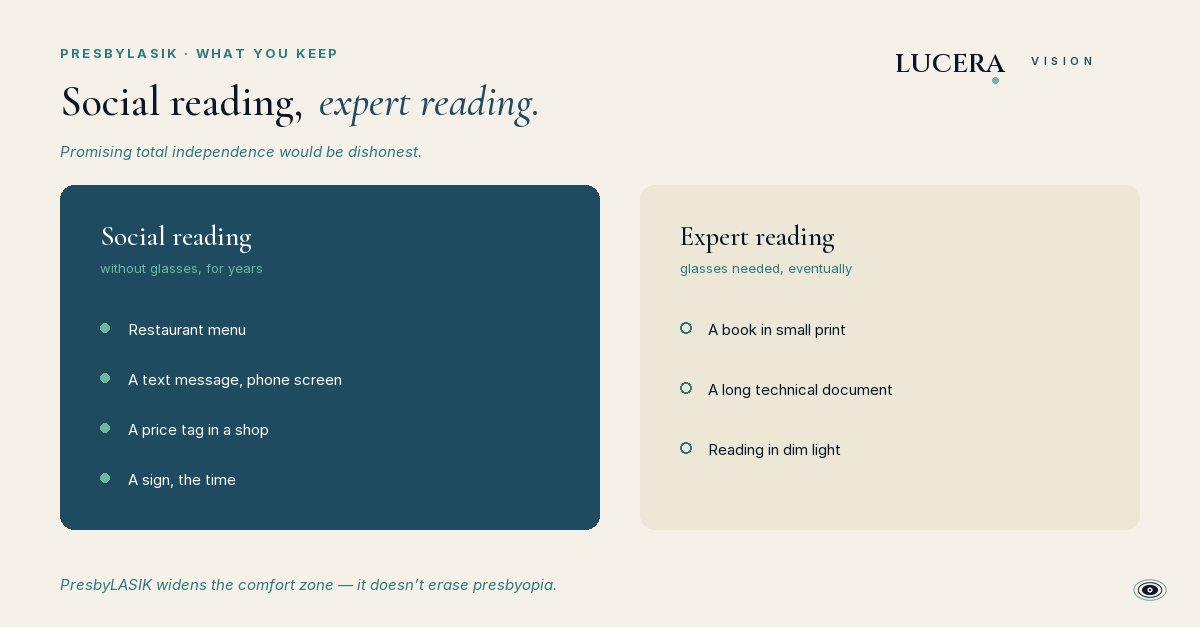
This is the distinction I make a point of setting out clearly with every patient.
PresbyLASIK makes it possible to maintain, for a long time, what I call social reading: reading a restaurant menu, checking a text message, deciphering a price tag in a shop, reading a sign, checking the time. These are the everyday actions that punctuate daily life, and for which having to search for glasses becomes a genuine inconvenience. The majority of my patients regain this independence and keep it for several years.
Expert reading, on the other hand, eventually calls for glasses again: a book in small print read at length in the evening, a technical work document consulted for hours, reading in poor lighting conditions. PresbyLASIK does not eliminate presbyopia — it widens the comfort zone, but that zone has limits, and they narrow slightly as presbyopia continues to progress with age.
This nuance is essential. Promising total and permanent independence from glasses would be dishonest. What I can reasonably offer is a daily life without glasses for the great majority of everyday uses — often for a long period.
Neuroadaptation and the result over time
The result of a PresbyLASIK is neither immediate nor instantly stable. The cornea has been reshaped to provide the brain with a new image quality, and the brain needs several weeks — sometimes a few months — to integrate this change and make the most of it.
During this adaptation period, vision may be somewhat fluctuating: some distances may appear sharper than others depending on the day, and slightly altered light perceptions may appear. This is expected and, in the vast majority of cases, these phenomena fade as neuroadaptation progresses.
I systematically warn my patients about this phase so that they do not worry: the first days or weeks do not correspond exactly to the final result.
PresbyLASIK is a bridge, not a final destination
It is important to stress this: the result of a PresbyLASIK is not definitive in an absolute sense. The lens continues to age after the procedure, residual accommodation continues to diminish, and eventually — often around 60–65 years of age for a patient treated at 45–50 — lens surgery becomes the natural option to make independence from glasses lasting.
This does not mean that PresbyLASIK is a failure that inevitably leads to lens surgery. It is a step that effectively postpones, sometimes for a decade or more, the need for a more invasive procedure — while preserving very comfortable visual quality of life in the meantime.
To understand how this later step unfolds and who it is for, you may consult the article: “Beyond the laser: lens surgery to correct presbyopia”.
The preoperative assessment
Before any PresbyLASIK, a complete assessment is essential: corneal topography to analyse the geometry of your cornea, pachymetry to measure its thickness, corneal biomechanics to test its strength, biometry to anticipate changes, and an examination of the ocular surface to assess dryness.
It is this assessment that determines whether PresbyLASIK is technically feasible and likely to benefit your eye — and that allows me to present you with a reasoned indication, rather than a generic proposal.
To understand the limits of laser surgery and the phakic implant alternative, you may consult the article: “How far can vision be corrected with laser or implants?”.
To understand how the implant is chosen when lens surgery becomes the next step, you may consult the article: “Choosing your implant: from presbyopia to refractive cataract surgery”.
This page presents general guidance drawn from my practice and current scientific literature. Each situation is assessed individually in consultation, on the basis of a complete preoperative assessment. It is not a substitute for personalised medical advice. — Dr Alexandre Balon, ophthalmic surgeon, Clinique Saint-Pierre Ottignies.