Laser
surgery
The Excimer laser reshapes the cornea with sub-micron precision to correct myopia, hyperopia and astigmatism. Several techniques share this principle, but differ in how they access the corneal tissue, their safety profile and their recovery kinetics.
How the laser
reshapes the cornea
The Excimer laser works by photoablation: each pulse vaporises a layer of corneal tissue a few micrometres thick, without heating or mechanical trauma to the adjacent tissues. By changing the curvature of the cornea, the point where light rays converge is moved exactly onto the retina.
The amount of tissue removed depends on the correction required: about 12 µm per dioptre of myopia at the centre of the treatment zone. The residual corneal thickness after treatment is one of the key parameters of the preoperative assessment — it determines long-term biomechanical safety.
All laser techniques share this same physical principle. What sets them apart is the way they access the stroma, the middle layer of the cornea where the photoablation is performed.
Possible correction
Myopia up to −8 D
Hyperopia up to +3 D
Astigmatism up to 4 D cyl.
Prerequisite
Sufficient corneal thickness and biomechanics. Refraction stable for at least 12 months. Preoperative assessment mandatory.
transPRK
Transepithelial photorefractive keratectomy — no-touch surface surgery
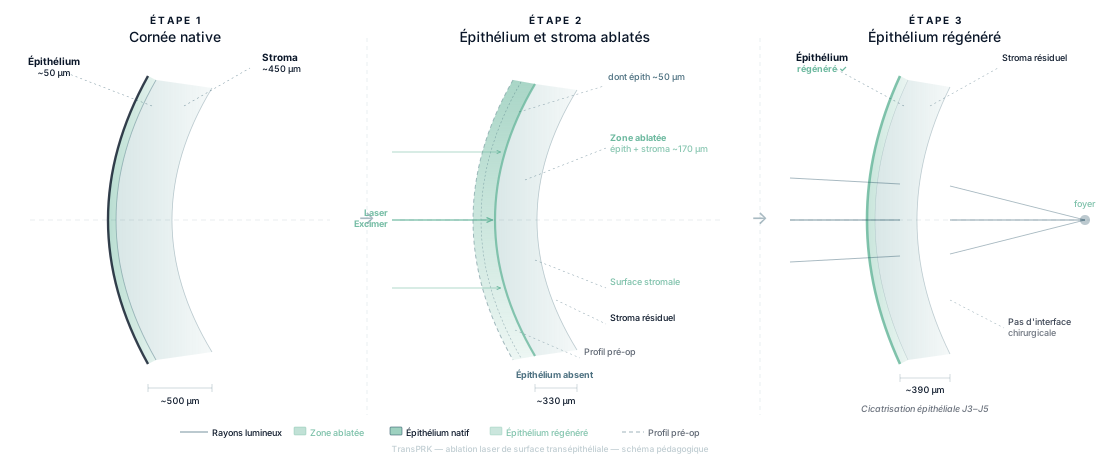
In transPRK, the Excimer laser simultaneously removes the corneal epithelium (the surface layer) and reshapes the underlying stroma, in a single continuous laser pass. No surgical instrument touches the eye: there is no mechanical brush, no alcohol, no flap cut.
The epithelium, removed by the laser, regenerates naturally within three to five days under a bandage contact lens. During this phase, the patient feels moderate discomfort or pain — similar to a foreign-body sensation — which gradually subsides as the epithelium closes over.
Vision remains blurred for about ten days and variable for two to four weeks, while the corneal surface stabilises. Anti-inflammatory and antibiotic eye drops are instilled several times a day for a few weeks.
Benefits
- No cut: biomechanical integrity preserved
- No complications related to a corneal flap
- Less postoperative dry eye
- Preserves more residual stromal tissue
- Safety profile established over several decades
Drawbacks
- Moderate discomfort or pain for the first 2–3 days
- Slow visual recovery (2–4 weeks)
- Strict, prolonged eye-drop regimen
- Fluctuating vision during the healing phase
FemtoLASIK
Laser In Situ Keratomileusis — femtosecond-laser cut
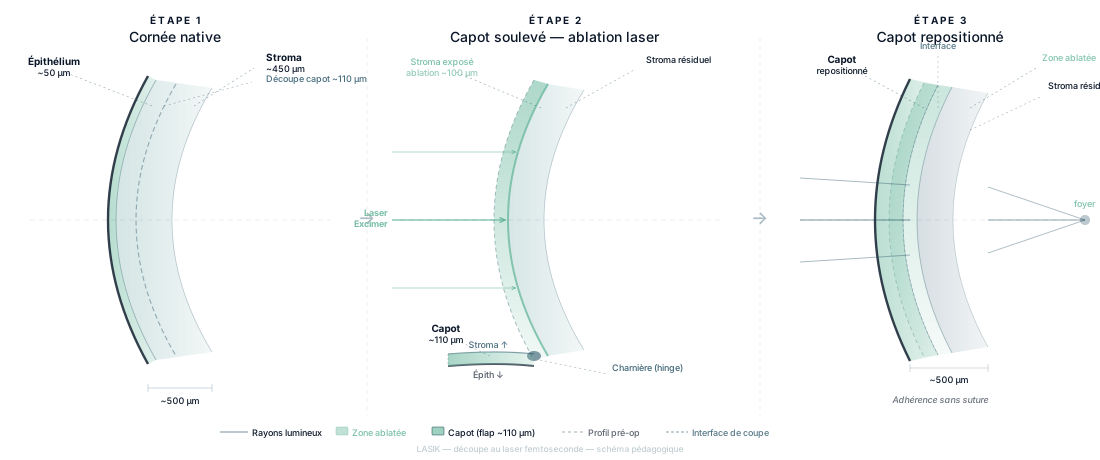
FemtoLASIK is performed in two stages. A femtosecond laser first cuts a thin circular flap in the cornea (the “flap”), about 110 µm thick. This flap is lifted, the Excimer laser reshapes the exposed stroma, then the flap is repositioned. It adheres spontaneously without sutures.
Visual recovery is fast: most patients regain functional vision within 24 hours, with little or no pain. This is the main advantage of this technique over surface surgery.
In return, the corneal flap never regains its original strength. The corneal nerves are severed when it is created, which increases the risk of postoperative dry eye — sometimes persistent. An eye injury could in theory displace the flap years after surgery, although this risk remains rare.
Benefits
- Fast visual recovery (24–48 h)
- Little or no postoperative pain
- Quick return to activities
Drawbacks
- Flap cut: possible complications (displacement, interface inflammation)
- Severed corneal nerves → more frequent dry eye
- Permanent flap: residual long-term fragility
- Less residual stromal tissue available
KLEx
Keratorefractive Lenticule Extraction — removal of an intracorneal lenticule
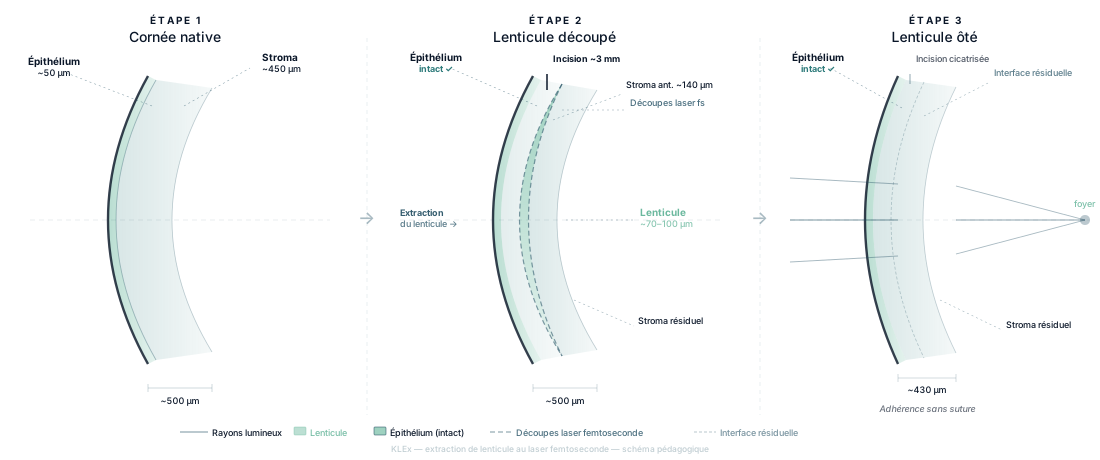
KLEx — also marketed as SMILE (Zeiss) or CLEAR (Ziemer) depending on the manufacturer — is based on a different principle: a femtosecond laser carves a lenticule (a thin lens of corneal tissue) inside the stroma, without opening the surface. This lenticule is then removed through a small 2-to-4 mm incision.
There is neither surface ablation (no epithelium removed) nor corneal flap: the surface of the eye remains intact. This approach offers a theoretical advantage in terms of biomechanical stability and dry eye compared with LASIK, with equivalent comfort.
However, KLEx remains inferior to transPRK on these two points and does not allow a direct laser enhancement if the result is not perfect.
Theoretical benefits
- No flap, no surface ablation
- Better biomechanical stability than LASIK
- Less dry eye than LASIK
- Faster recovery than surface surgery
Limits
- Surface-laser enhancement more complex
- Biomechanical stability lower than transPRK
- More dry eye than transPRK
This technique is not currently offered within Dr Balon's practice. Patients who are candidates for corneal surgery are offered transPRK or FemtoLASIK depending on their preoperative assessment.
PresbyLASIK
Presbyopia correction by multifocal corneal ablation
PresbyLASIK — of which the PresbyMAX module is one implementation — is a variant of the laser ablation profile designed to compensate for the loss of accommodation associated with presbyopia. Instead of a uniform ablation, the laser creates a multifocal corneal profile: a central zone optimised for near vision, and a peripheral zone for distance vision.
This approach is intended for presbyopic patients wishing to reduce their dependence on reading glasses, whether they are also myopic, hyperopic or astigmatic. It can be performed in addition to a transPRK or LASIK treatment.
The brain must adapt to this new organisation of the focal point: a period of neuroadaptation is needed, generally from a few weeks to a few months. Not all patients adapt to it with the same ease. Some discomfort in night vision (halos, glare) is possible and eases with time.
Key point
Presbyopia results from the ageing of the lens, not of the cornea. PresbyLASIK acts on the cornea to compensate for this loss of accommodation, without treating its cause. With age, presbyopia continues to progress: the functional result is therefore likely to change over time, even after successful surgery.
Why transPRK
is my technique of choice
FemtoLASIK offers faster visual recovery and greater postoperative comfort in the first few days. These are real advantages I do not overlook. Yet, for the great majority of patients, I favour transPRK — and here are the medical reasons that guide this choice.
No instrument touches the eye
transPRK is performed entirely with the laser, without any mechanical cut or manipulation of the corneal surface. This absence of contact reduces the variability linked to the surgical step and eliminates a whole category of potential complications.
No permanent corneal flap
The flap created during a LASIK never fully heals shut. It remains a permanent interface that can be displaced by trauma — even minor, even years after surgery. For active patients or those practising contact sports, this residual risk is not negligible.
Better preservation of corneal nerves
Cutting the LASIK flap severs a large number of corneal nerves, which explains the more frequent and more intense postoperative dry eye than after transPRK. For patients who already have pre-existing dry eye, this can be decisive in the choice of technique.
Biomechanical integrity preserved
In the absence of a flap, the structural strength of the cornea is better preserved after transPRK. This parameter is particularly important for high corrections or for corneas at the limit of indication, where every micrometre of residual tissue counts.
Equivalent long-term results
Comparative studies show that refractive results at one year and beyond are comparable between transPRK and FemtoLASIK. The slowness of the initial recovery does not predetermine the quality of the final result. It is a temporary inconvenience, not a compromise on effectiveness.
What this means for you
Choosing transPRK means accepting a more demanding week of recovery — frequent eye drops, bandage contact lens, blurred vision — in exchange for a surgical risk profile that I consider more favourable in the long term. I explain this systematically in consultation, and the final choice always belongs to the patient.
There are situations where FemtoLASIK remains the most appropriate indication — corneal thickness allowing a comfortable flap, professional constraints requiring fast recovery. In those cases, I offer it. The indication always comes before preference.
Your preoperative assessment
determines the technique
Corneal topography, pachymetry, biomechanics, aberrometry: the preoperative examination is the step that determines everything that follows. Contact us to arrange a consultation.