The phakic implant
When the correction is too high for corneal reshaping, or the anatomy of the cornea rules out the laser, an artificial lens is placed inside the eye — in front of the natural lens, which is preserved intact. The procedure is reversible.
When laser
is not enough
Corneal laser surgery relies on removing a volume of corneal tissue. This ablation has a twofold limit: the desired correction cannot exceed what the thickness and biomechanics of the cornea allow to be removed safely, and certain corneal morphologies rule out any reshaping.
In these situations, a phakic intraocular lens — placed inside the eye without touching the cornea — makes it possible to reach corrections beyond the laser's range, with a different and complementary safety profile.
High correction
Myopia up to −18 D, high hyperopia (subject to suitable anatomy): the amount of corneal tissue to be removed exceeds the biomechanical safety limit. The phakic implant takes over without any corneal constraint.
Insufficient cornea
A cornea that is too thin, irregular or shows a suggestive topography: the laser is contraindicated in order to preserve the long-term structural integrity of the cornea.
Pre-existing dry eye
Surface surgery and LASIK sometimes worsen existing dry eye. The phakic implant, which does not alter the cornea, causes less postoperative dryness.
ICL
Visian Implantable Collamer Lens — STAAR Surgical
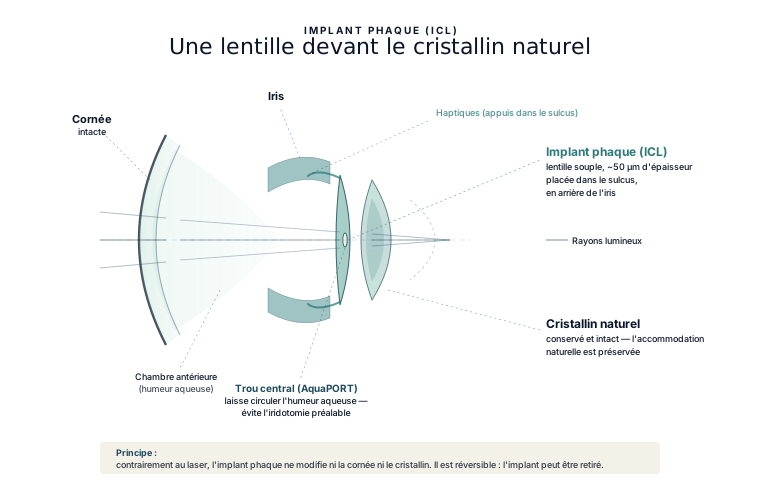
The ICL is a flexible lens made of a hybrid material — plastic and collamer (a biocompatible synthetic collagen) — that folds to be introduced into the eye through a 2-to-3 mm corneal micro-incision. Once in place, it unfolds and settles naturally between the iris (the coloured part of the eye) and the natural lens, which is kept intact with its ability to accommodate.
The ICL works in addition to the natural lens: it does not replace it, it adds its refractive power to the lens's own to bring the point of convergence exactly onto the retina.
The procedure is performed as a day case, in a sterile operating theatre, under topical (eye-drop) anaesthesia or general anaesthesia, according to the patient's preference. Both eyes are treated on the same day.
Correction range
Benefits
- Cornea not altered — micro-incisions only
- Very wide correction range
- Less dry eye than with the laser
- Natural lens and accommodation preserved
- Reversible: removal or exchange possible
- Excellent optical quality, including for high corrections
Prerequisites
- Anterior segment deep enough to house the implant safely
- Adequate endothelial cell density
- No cataract or glaucoma
- Complete anatomical assessment mandatory
IPCL
Implantable Phakic Contact Lens — Care Group Sight Solutions
The IPCL is a second-generation phakic lens, developed after STAAR's ICL. It shares the same positioning principle in the posterior chamber, between the iris and the lens, and corrects the same refractive errors over comparable ranges.
Its design incorporates the experience accumulated with the ICL: the lens is thinner at the periphery, its centring is optimised for anterior chambers of varied geometry, and its toric design (astigmatism correction) is particularly precise. Like the ICL, the IPCL is biocompatible and can be removed or exchanged if necessary.
The choice between ICL and IPCL is determined during the preoperative assessment, based on the anatomical characteristics of the eye, the desired correction and the availability of models for the required power. Both options are discussed in consultation.
ICL vs IPCL — what differs
- Different manufacturer → independent power calculation
- Slightly different edge profile and geometry
- Variable stock availability and ordering times
- Both are placed in the posterior chamber
- Both are reversible
Please note
Long-term follow-up data are more extensive for the ICL (on the market since the 1990s) than for the IPCL (more recent). This difference is taken into account in the preoperative discussion.
A reversible
procedure
Unlike corneal surgery, which permanently changes the shape of the cornea, the phakic implant can be removed or exchanged with a simple surgical step. This reversibility is a real advantage in several situations: a change in refraction with age, the development of a cataract requiring lens replacement, or simply the patient's wish.
It does not mean the procedure is without consequence, nor that removal is routinely recommended — but it offers a flexibility that corneal surgery cannot provide.
Removal or exchange possible with simple surgery
Corneal tissue removed permanently
Natural lens removed and replaced
The anatomy of your eye
determines the indication
The depth of the anterior segment, the endothelial cell density and the desired refraction are the key parameters. They are measured during the preoperative assessment, before any surgical decision.